DashJur

OVERVIEW

DashJur is a legal intelligence platform designed to help corporate legal departments and law firms transform litigation data into strategic decision-making.

Built on top of a live database containing more than 2 billion Brazilian legal cases, the platform enables organizations to monitor legal exposure, benchmark performance against the market, forecast potential losses, and identify patterns hidden within large volumes of judicial data.

Unlike traditional legal research tools, DashJur combines analytics, predictive intelligence, competitive benchmarking, and portfolio management in a single environment, allowing legal teams to move from reactive operations to data-driven legal strategy.

YEAR

2025

ROLE

Product Designer

IMPACT

Validated a scalable legal analytics solution built on top of 2b+ legal records

IMPACT

Validated a scalable legal analytics solution built on top of 2b+ legal records

RESPONSABILITIES

Product Strategy, Data Visualization, UX/UI Design, Stakeholder Collaboration

RESPONSABILITIES

Product Strategy, Data Visualization, UX/UI Design, Stakeholder Collaboration

The Opportunity

DashJur originated from a custom request made by one of Brazil's largest airline companies. The legal team needed more than operational case management. They needed strategic visibility into litigation patterns, court behavior, success rates, and procedural trends while comparing those insights against their own litigation portfolio.

What started as a client-specific solution revealed a broader market opportunity. Research and stakeholder conversations showed a growing demand for legal analytics among corporate legal departments and law firms seeking more data-driven decision-making.

Understanding the Problem

Information Inaccessible

Complaint information was spread across multiple agencies and systems. Different workflows created fragmentation, inefficiencies, and operational complexity.

Limited Strategic Visibility

Complaint management relied on spreadsheets, emails, and disconnected tools. Manual workflows created inefficiencies, duplicated effort, and operational complexity.

From Experience to Intelligence

Teams lacked centralized visibility into deadlines, statuses, and outcomes. Limited control increased operational, financial, and reputational risks significantly.

Defining the Product Strategy

Enterprise Legal Teams

Focus on organizations managing large litigation portfolios and requiring strategic visibility across thousands of cases, jurisdictions, legal matters, and business risks to support decision-making at scale.

Data-Driven Decision Making

Transform legal data into actionable insights for risk assessment, legal strategy, operational planning, and portfolio optimization, enabling faster and more informed business decisions.

Comparative Intelligence

Combine public legal data with proprietary customer information to create benchmarking, competitive analysis, market positioning, and predictive intelligence capabilities across industries and jurisdictions.

Key Product Decisions

Prioritizing Data Quality

Established a reliable analytical foundation before expanding reporting capabilities, ensuring consistency, accuracy, and trust in every insight generated by the platform.

Analytics Over Operations

Focused on strategic insights rather than case management workflows, positioning the product as a decision-making tool rather than a traditional legal operations platform.

Enterprise Flexibility

Designed the solution to adapt to different customer realities and business needs, enabling customized implementations without creating a one-size-fits-all product.

Designing a Legal Intelligence Ecosystem

Most legal analytics platforms focus on reporting. DashJur was designed to support decision-making.

The challenge was not simply providing access to judicial data, but transforming billions of legal records into actionable intelligence that could guide legal strategy, risk management, and operational decisions.

To achieve this, we structured the product around five interconnected experiences, each addressing a different stage of the legal intelligence journey, from understanding the market landscape to analyzing individual cases and forecasting financial exposure.

Together, these modules create a complete ecosystem where legal teams can move seamlessly between portfolio management, competitive benchmarking, predictive analysis, and strategic decision-making.

Panorama Legal

The strategic entry point of the platform. Panorama Legal provides a consolidated view of the organization's litigation landscape, combining portfolio volume, financial exposure, success rates, duration metrics, and geographic distribution of cases. The experience was designed to help legal leaders quickly understand the overall health of their operation and identify the areas that require immediate attention.

Process Import

Bringing proprietary litigation data into the intelligence ecosystem. The journey begins with data. Through a guided import experience, organizations can upload their own litigation portfolio and connect it to DashJur's legal intelligence layer. The process supports structured datasets containing case information, financial exposure, procedural status, and legal metadata, creating a unified foundation for analysis across the platform. By combining proprietary legal data with billions of judicial records, organizations gain access to benchmarking, predictive insights, and strategic intelligence tailored to their specific litigation landscape.

Portfolio Management

A centralized environment for managing imported legal portfolios. Organizations can upload their own litigation database and monitor every case in a structured way, including financial exposure, risk level, probability of success, procedural updates, and strategic relevance. This module transforms fragmented legal information into an organized and searchable portfolio, creating the foundation for deeper analysis across the platform.

Case Intelligence

Moving from portfolio-level visibility to case-level decision-making. Once a legal portfolio has been imported and organized, teams often need to investigate specific lawsuits that carry strategic, financial, or operational relevance. Case Intelligence provides a dedicated workspace where users can explore an individual case in depth, including procedural history, similar precedents, success probability, financial exposure, and key legal arguments. By transforming complex case data into structured intelligence, the experience helps legal professionals understand risks faster, identify opportunities, and make more informed decisions with greater confidence.

Competitive Intelligence

Benchmarking legal performance against the market. This module enables organizations to compare litigation performance, exposure levels, resolution times, and success rates against competitors and market benchmarks. By providing a broader market perspective, legal teams can identify competitive advantages, uncover inefficiencies, and make more informed strategic decisions.

Financial Provisioning

Predicting financial exposure through data-driven scenarios. The Provisioning module helps organizations estimate potential losses using predictive models and probability-based scenarios. By simulating different outcomes and confidence intervals, legal and finance teams can better understand risk exposure, define reserve strategies, and support executive decision-making with greater accuracy.

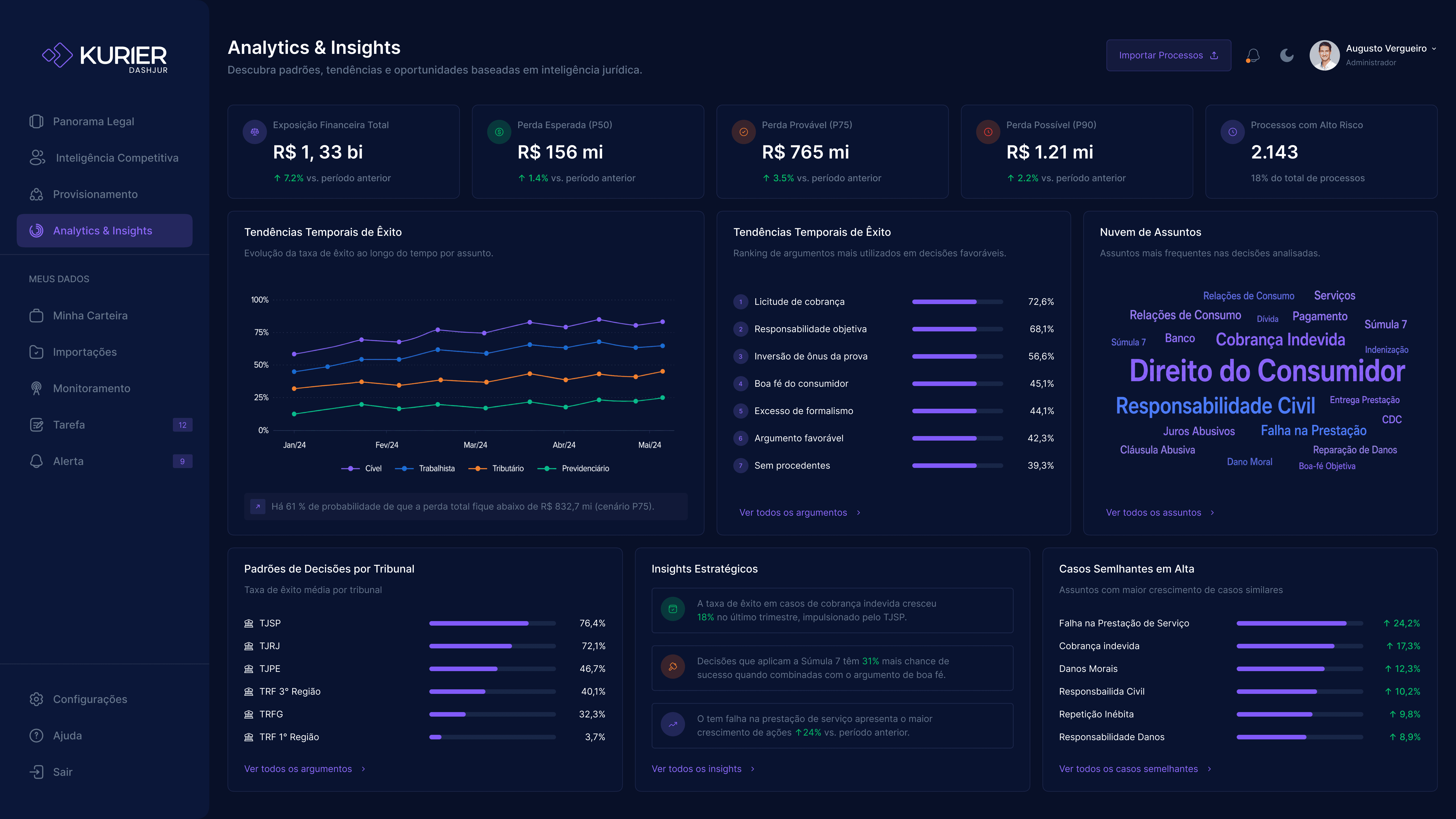
Analytics & Insights

Transforming legal data into strategic intelligence. This module uncovers patterns hidden within large volumes of judicial data. Through advanced analytics, users can identify emerging trends, successful legal arguments, tribunal behavior, and recurring litigation topics. Rather than simply reporting historical information, Analytics & Insights helps organizations anticipate future outcomes and continuously improve their legal strategy.

From Data to Decision-Making

By connecting portfolio management, competitive benchmarking, case analysis, financial forecasting, and strategic insights into a single experience, DashJur transforms legal data into a decision-making system. The result is a platform that helps organizations move from reactive litigation management to proactive legal intelligence.

Strategic Positioning

One of the key challenges involved positioning the product within an existing portfolio of legal analytics solutions. The organization already offered a well-established legal analytics product. Launching DashJur as a fully standardized solution risked creating overlap and internal competition.

Instead, the decision was to position DashJur as a configurable enterprise solution. This approach preserved portfolio differentiation while enabling the company to address highly specific customer needs through tailored implementations.

Strategic Positioning

One of the key challenges involved positioning the product within an existing portfolio of legal analytics solutions. The organization already offered a well-established legal analytics product. Launching DashJur as a fully standardized solution risked creating overlap and internal competition.

Instead, the decision was to position DashJur as a configurable enterprise solution. This approach preserved portfolio differentiation while enabling the company to address highly specific customer needs through tailored implementations.

Impact & Learnings

Market Validation

Confirmed strong demand for advanced legal analytics among enterprise legal teams and law firms, validating the opportunity for a scalable data-driven product.

Scalable Foundation

Created a reusable product foundation capable of supporting multiple enterprise implementations and customized deployments.

Key Learning

Successful products are built by balancing market opportunity, customer needs, and business strategy not just solving isolated problems.

Panorama Legal

The strategic entry point of the platform. Panorama Legal provides a consolidated view of the organization's litigation landscape, combining portfolio volume, financial exposure, success rates, duration metrics, and geographic distribution of cases. The experience was designed to help legal leaders quickly understand the overall health of their operation and identify the areas that require immediate attention.

Process Import

Bringing proprietary litigation data into the intelligence ecosystem. The journey begins with data. Through a guided import experience, organizations can upload their own litigation portfolio and connect it to DashJur's legal intelligence layer.The process supports structured datasets containing case information, financial exposure, procedural status, and legal metadata, creating a unified foundation for analysis across the platform. By combining proprietary legal data with billions of judicial records, organizations gain access to benchmarking, predictive insights, and strategic intelligence tailored to their specific litigation landscape.

Competitive Intelligence

Benchmarking legal performance against the market. This module enables organizations to compare litigation performance, exposure levels, resolution times, and success rates against competitors and market benchmarks. By providing a broader market perspective, legal teams can identify competitive advantages, uncover inefficiencies, and make more informed strategic decisions.

Portfolio Management

A centralized environment for managing imported legal portfolios. Organizations can upload their own litigation database and monitor every case in a structured way, including financial exposure, risk level, probability of success, procedural updates, and strategic relevance. This module transforms fragmented legal information into an organized and searchable portfolio, creating the foundation for deeper analysis across the platform.

Case Intelligence

Moving from portfolio-level visibility to case-level decision-making. Once a legal portfolio has been imported and organized, teams often need to investigate specific lawsuits that carry strategic, financial, or operational relevance. Case Intelligence provides a dedicated workspace where users can explore an individual case in depth, including procedural history, similar precedents, success probability, financial exposure, and key legal arguments.By transforming complex case data into structured intelligence, the experience helps legal professionals understand risks faster, identify opportunities, and make more informed decisions with greater confidence.

Financial Provisioning

Predicting financial exposure through data-driven scenarios. The Provisioning module helps organizations estimate potential losses using predictive models and probability-based scenarios. By simulating different outcomes and confidence intervals, legal and finance teams can better understand risk exposure, define reserve strategies, and support executive decision-making with greater accuracy.

Analytics & Insights

Transforming legal data into strategic intelligence. This module uncovers patterns hidden within large volumes of judicial data. Through advanced analytics, users can identify emerging trends, successful legal arguments, tribunal behavior, and recurring litigation topics. Rather than simply reporting historical information, Analytics & Insights helps organizations anticipate future outcomes and continuously improve their legal strategy.

Panorama Legal

The strategic entry point of the platform. Panorama Legal provides a consolidated view of the organization's litigation landscape, combining portfolio volume, financial exposure, success rates, duration metrics, and geographic distribution of cases. The experience was designed to help legal leaders quickly understand the overall health of their operation and identify the areas that require immediate attention.

Process Import

Bringing proprietary litigation data into the intelligence ecosystem. The journey begins with data. Through a guided import experience, organizations can upload their own litigation portfolio and connect it to DashJur's legal intelligence layer.

The process supports structured datasets containing case information, financial exposure, procedural status, and legal metadata, creating a unified foundation for analysis across the platform. By combining proprietary legal data with billions of judicial records, organizations gain access to benchmarking, predictive insights, and strategic intelligence tailored to their specific litigation landscape.

Portfolio Management

A centralized environment for managing imported legal portfolios. Organizations can upload their own litigation database and monitor every case in a structured way, including financial exposure, risk level, probability of success, procedural updates, and strategic relevance. This module transforms fragmented legal information into an organized and searchable portfolio, creating the foundation for deeper analysis across the platform.

Case Intelligence

Moving from portfolio-level visibility to case-level decision-making. Once a legal portfolio has been imported and organized, teams often need to investigate specific lawsuits that carry strategic, financial, or operational relevance. Case Intelligence provides a dedicated workspace where users can explore an individual case in depth, including procedural history, similar precedents, success probability, financial exposure, and key legal arguments. By transforming complex case data into structured intelligence, the experience helps legal professionals understand risks faster, identify opportunities, and make more informed decisions with greater confidence.

Competitive Intelligence

Benchmarking legal performance against the market. This module enables organizations to compare litigation performance, exposure levels, resolution times, and success rates against competitors and market benchmarks. By providing a broader market perspective, legal teams can identify competitive advantages, uncover inefficiencies, and make more informed strategic decisions.

Analytics & Insights

Transforming legal data into strategic intelligence. This module uncovers patterns hidden within large volumes of judicial data. Through advanced analytics, users can identify emerging trends, successful legal arguments, tribunal behavior, and recurring litigation topics. Rather than simply reporting historical information, Analytics & Insights helps organizations anticipate future outcomes and continuously improve their legal strategy.

Financial Provisioning

Predicting financial exposure through data-driven scenarios. The Provisioning module helps organizations estimate potential losses using predictive models and probability-based scenarios. By simulating different outcomes and confidence intervals, legal and finance teams can better understand risk exposure, define reserve strategies, and support executive decision-making with greater accuracy.

YEAR

2025

ROLE

Product Designer

IMPACT

Validated a scalable legal analytics solution built on top of 2b+ legal records

RESPONSABILITIES

Product Strategy, Data Visualization, UX/UI Design, Stakeholder Collaboration

Interested to work with me?
ayronigorbarbosa@gmail.com +55 81 99868 4925

1:08:26 AM

Interested to work with me?
ayronigorbarbosa@gmail.com +55 81 99868 4925

1:08:26 AM

Interested to work with me?
ayronigorbarbosa@gmail.com +55 81 99868 4925

1:08:26 AM